|
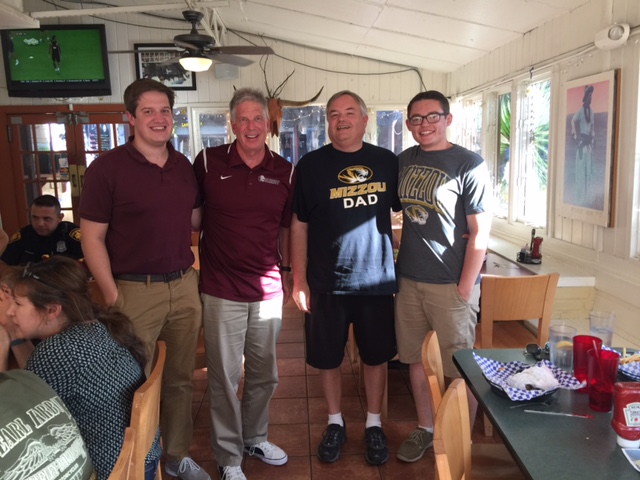
| At HOF induction 2012 (courtesy W. Terrell) |
February
6, 2018 – Rick Roberts Memorial Service Remarks
My name is David Tuttle and I have been friends with Rick
for the past 24 years. I am humbled that I have the opportunity to say a few
words to you today. I think Dacia is worried that I will talk too long. Mostly
because she sent me a text that said “don’t talk too long.” Nah, not really.
But do get comfortable. Rick is going to get his due.
I love that today is Rick’s birthday though I am not a huge “birthday” guy. Rick hated it when I would forget his birthday. Hated it. When he was at Trinity by day’s end he would call me and say something like, “Hey, did you want to tell me happy birthday, I’m leaving soon…” I always dreaded forgetting his birthday. Well, I will never forget now.
If he were here, Rick would be thrilled and probably a little uncomfortable with this crowd. After greeting you, despite this being his memorial service, we all know he would quickly turn the conversation to you. Asking about how you are doing. Right? Then he’d ask you for money!
Thank you all for being here. I want to especially thank and acknowledge some people on his behalf.
First, Welcome to all of the people from Trinity University, who just loved Rick so much. He left, but never left us behind.
I want to thank the Texas Lutheran community who quickly learned what we knew about Rick and who embraced him, and who he embraced, after TLU President Stuart Dorsey stole him from us at Trinity. I shake my fist at you Dr. Dorsey.
I want everyone here to know what a wonderful president and man Stuart Dorsey is. His unwavering support for Rick in so many dimensions reflects his kindness, generosity, leadership, and friendship. Rick repeatedly told me how much this meant to him and was stunned at how much Dr. Dorsey supported him and Dacia the last couple of years. I want to thank Debbie Cottrell, Kristi Quiros, and other members of the cabinet for their friendship and support of Rick. He loved all of you.
Last night there was an informal celebration of Rick’s life with his extended family and many of his close friends from Seguin and TLU. Rick’s colleague Sam Ehrlich gave a wonderful eloquent and emotional talk about Rick and what he meant to his team. (You need to share that Sam.) It made me realize that while Rick was loved at Trinity, he is beloved here at TLU. I guess we got to rent him whereas TLU got to own him. What a testament to Rick that he had such an impact professionally and he did it in a very personal way.
I want to acknowledge the caregivers from the hospital for their wonderful treatment they provided Rick. I would jokingly say to them “I want the best treatment for my friend here,” as though I had any authority. But they were giving it anyways. He touched them like he did all of us. His incredible spirit and wit inspired them and he was their best and favorite patient.
I want to welcome Rick’s family, many whom have traveled here from New Mexico. I got to meet many last night including siblings, in-laws, nieces and nephews. What wonderful caring, and expressive people. Being around Rick’s friends and family really helps you see why he was such a quality guy. He was surrounded by awesome people.
I want to acknowledge my wife Donna and my kids. When Rick took me on as a friend it was truly a family affair and the connections between all of us, especially the four of us have been so meaningful and we are all hurting.
I want to thank my friend Raphael Moffett for teaching me to say I love you to male friends. I was able to say this to Rick, though I still have to add the word “man” at the end. But I was able to tell him how I felt during this past year, thanks to you Moff.
To Elizabeth and EJ, I just want to tell you how proud your dad was of you and how much he loved you and Mandy and Arthur. His life revolved around you. You probably don’t see it this way, but you gave your dad a tremendous gift. Watching him grow and change because of you has been so gratifying. Through you he had to reconsider some of his viewpoints. He was always a good Christian. But you opened his eyes and heart in ways he never saw coming. You turned a good Christian into a true Christian.
Finally, I don’t know what to say about Dacia. She accompanied Rick through his illness with selflessness, love, and support. I can’t sit in the waiting room at the Med Clinic with my family for 30 minutes before I’m like “uh, I’m hungry, I’m missing the game… what’s this going to cost.” Rick turned all matters of his illness over to Dacia. She was there as his researcher and advocate, hour by hour, day by day, week by week, and month by month. She drove a lot. She never wavered. Ever. All of us marvel at you Dacia and what you did.
My wife reminded me, though, that your relationship shouldn’t be defined by the last two years. It would be like judging Sean Elliott’s career on the Memorial Day Miracle shot. (That’s my analogy, not my wife’s.) But Rick and Dacia were married for 38 years, which is amazing. They had two kids together, managed other health issues, grieved the loss of family members together, shared several homes, traveled regularly to New Mexico and Colorado after moving to Texas, and experienced all of the joy and challenges of a sustained relationship. Dacia, you meant everything to Rick, and he loved you with everything he had. You were a great wife and he was lucky to have you. For you, Dacia, to lose him, now, is just so hard. We all love you.
I met Rick when I came back to Trinity in 1994. Our friendship evolved from the basketball court, to running, and to connecting outside of work. We ran together after the attacks on 911 and shortly thereafter we started training for half and full marathons. When you run with someone that much you get really close. We shared everything about our work, our families, about how lucky our wives were to have us and about how right we were.
We shared a common love for the Spurs, as many of us do. We were at game two of the Minnesota series in 1999, together when we lost. We were mad. We were at the Laker game later that year when the Lakers had a foul to give but instead let Tim Duncan hit the game winner. We celebrated. We probably dissected hundreds of Spurs game on our runs together. The last time I saw Rick it was at the rehab hospital where we got to watch one last game together.
When I was the subject of a roast at Trinity it was Rick who landed the best blows. And when he left Trinity, I was able to talk about him at his farewell reception. And then there’s this. Outside my family, my friendship with Rick has been the most significant relationship of my adult life. I was so lucky to have a best friend with the same interests, the same sense of humor, and the same values. We knew one another’s weaknesses and flaws as well, but didn’t care. Our friendship was unconditional and easy.
I learned last night, that I probably can’t tell you anything you probably didn’t know or haven’t felt. Rick was consistent and treated everyone the same. But here are some things that need to be read into the record.
Rick had a tremendous sense of humor. Rick always reminded me of one of his favorite comedians, Jerry Seinfeld. His keen observations, his funny comebacks, his self-deprecation... He would see humor in most everything and he would retell stories of his missteps in ways that would have you rolling. Even to the end, he was always cracking jokes with the hospital staff.
Rick was the nicest guy in the world. I often felt like I was George to his Jerry. Whenever I was slighted at work or elsewhere, as I often am, Rick was an incredible sounding board. He had a way of listening, not over-reacting, and making me feel good about myself and helped me feel supported. Even at the hospital, he treated the staff with incredible respect and kindness. He could work a room because he wanted to meet people and to learn about them and support them too, but he never really worked people. It was always genuine. When you were with Rick you felt important and that you mattered.
Rick was extremely generous. He was in the perfect job. He got appropriately frustrated when I would tell people to watch their wallets when Rick approached. That’s because he never saw himself as someone who would separate people from their money. He was a steward of people’s resources as he helped them help others.
Now Rick would see this next bit as the most important part of my talk, so humor us. He was a great basketball player, even at his age, and I gotta break down his game for you!
Inducted into the Trinity Noon Ball Hall of Fame in 2012 (yes, that is a real thing), he was always one of the best players out there. He played how he lived his life. He worked hard, had great skill, expected excellence, and was a great teammate and sport. I hated guarding him because he always moved without the ball and knew how to set and use screens. He was a tenacious defender. He was probably the best and most consistent three-point shooter we had on the court. And he was often the best passer. He was the king of the touch pass. That was Rick, he shared the ball like he shared everything else.
 |
| Rick and Trich: with bald buddy Kellyn, July 4, 2017 |
Rick was a man of great faith. When we had Kellyn in 2002 we knew we wanted
Rick and Dacia to be the godparents, despite them not being Catholic. When I
went and did the paperwork, the Deacon said we couldn’t use them. They weren’t
Catholic. They were the most Christian couple we knew, so I went to another
church, Our Lady of Grace. This time I knew the question would come up so I was
better prepared. I figured it was bad form to lie to a priest, so let’s just
say I was evasive when the late Monsignor Walsh asked me about Kellyn’s
sponsors.
I think he knew, but he got it, so he didn’t press the issue. He waved them
through. Every year thereafter, without fail, Rick and Dacia would come over
with breakfast to celebrate Kellyn’s baptism date. They were always active in
their faith communities and Rick was guided by his faith until the end.
Finally, I had no idea how resilient Rick was until his illness. I am not a fan
of when people say someone was strong, or they fought hard. I think people deal
with adversity the way they deal with it. No weak or strong. They simply cope
the best they can. But I learned so much from Rick. I always assumed people
fought illnesses from a place of fear. That’s how I would do it.
But Rick always fought from a place of hope, strength, and his eternal positive attitude. I should have figured. When we would play basketball and I would take a hard foul I would inevitably let out this kind of involuntary yelp. And Rick would just shake his head. “You okay there?” he would say with his sheepish grin. He was tougher. For crying out loud, he just learned this fall that he had a heart defect his whole life.
When I would turn the ball over, as I am prone to do, and then stop to pout, Rick would always admonish me to get back on defense. He would never give up. He was fearless and determined.
I tried to engage Rick about how he was feeling, emotionally, these past two years. He wouldn’t bite. Dacia recounted to us last week that Rick told her that it was odd that I asked him if he was afraid to die. She reminded him that, well, he did have stage 12 cancer. But he said he that while he didn’t want to die, he wasn’t afraid.
Rick looked ahead, never skipping steps, and never losing faith. He was focused fully on the next thing and not one step beyond. When Rick told me he had cancer, it was over coffee at Starbucks. “So, I need to tell you something…” he started. He was almost sheepish about it. Almost embarrassed. It was like he was going to tell me that he dented my car. This illness was never bigger than him. Setback after setback and obstacle after obstacle were placed in his way. Despite pain and extreme discomfort Rick never complained. Dacia says that during his rehab, when they said do five reps Rick would say let’s do ten. When they would say ten minutes he would say 20.
Even when I saw this coming I never really expected it. Like Rick, I never really wanted to look up. And today, I do look up, and I see all of you. Rick was my best friend. You naturally see people mostly in the context of how you know them. I was speechless last night and a little disoriented as I was reminded that Rick was much more than my friend. Husband, dad, brother, son, co-worker, friend, noon-baller, donor. He belonged to everyone in much the same way. Without doubt, Rick made an incredibly positive impact on everyone who knew him. Even now. Ironically, on this day, he is the gift-giver and always has been. I love you Rick. We all love you. Happy birthday.