Google Analytics Tracking Code

Monday, August 31, 2015

All in: Optimal Buzz and B'low Optimal at Trinity University

Optimal Swag
After a two-year pilot program, Trinity has fully rolled out its B'low Optimal alcohol program this fall. The program offers on-campus students an incentive to drink according to Optimal Buzz program guidelines, created several years ago by Dr. Richard Reams Associate Director of Counseling Services.

For years Trinity University worked with students, faculty, and staff, through the Trinity Alcohol Coalition to develop cohesive messages and programs that fit to these three tenets: we acknowledge students will drink; we care deeply about student health and safety; and we will follow our alcohol policy as proscribed by law.

Our Responsible Friend policy acknowledges students will drink and shows we care about them by letting students off the hook if someone calls for help because they see another student in crisis related to alcohol. No one gets in trouble. Lawful alcohol at tailgates is now part of policy and complies with these tenets. Beer and wine are served in the Skyline Room for various events. There are many examples.

We have been reflecting this approach through a brief and practical video/slide show we send to new students and publish on our alcohol web page:


Dr. Reams used to talk about the Optimal Buzz with first year residence hall students, but we were only hitting about half of each class. We produced a video this year that was shown at New Student Orientation to all new students, with much greater reach. It acknowledges that students will drink and teaches them how to drink like (most) adults - to be safe and drink in moderation:


The B'low Optimal program takes the Optimal Buzz a step further. If students are caught drinking, but say "I wanna blow," the Residential Life staff allows them to opt-in for a breathalyzer reading. If they are within the Optimal Buzz range up to .06 BAC, then they only receive a pre-warning. This acknowledges students will drink, shows we care about their health and safety, and still complies with policy (just with an adjusted sanction - the pre-warning).


This is self-sustaining, financially, as we have used student fine money from alcohol and drug cases to fund the videos, new breathalyzers, and some of the items pictured above: shirts for new students; cups, with serving-size markers for sophomores; and bottle openers for juniors and seniors. Next year seniors will receive shot glasses that state: "This is ONE drink - Go Optimal."  The staff is doing an accompanying poster campaign as well.

Let's face it. Many alcohol education programs miss the mark. We will be assessing this approach to see if it is effective in reducing excessive drinking. Early reviews in the pilot program were promising, though we learned many lessons that have been addressed in the new full program.

Monday, July 13, 2015

Pizza and Pleasure Redux

In January 2014 I wrote about some push back to the Trinity Pizza & Pleasure program. This series offers sex education and pizza (as an incentive to draw attendance). Briefly, some (mostly parents - and not many) objected that the series seemed to emphasize promiscuity and there was no forum for alternatives. Program architect Dr. Richard Reams agreed to add some different topics. Here is the lineup and attendance figures from 2014-2015:
  • Getting What You Want from Sex (Sept. 18; 60 attendees) Presented by Cay Crow.
  • Getting What You Want from Abstinence (Sept. 25; 22 attendees) Presented by Ms. Crow.
  • Body Image and Sexuality (Oct. 2; 20 attendees) Presented by Ms. Crow.
  • Sexual Orientation and Identity (Oct 9; 22 attendees) Presented by Dr. Richard Reams.
  • The Secrets of Love (Jan 22; 33 attendees) Presented by Dr. Erin Sumner.
  • The Secrets of Dating (Jan 29; 32 attendees) Presented by Dr. Sumner.
  • The Secrets of Men’s & Women’s Sexuality (Feb. 5, 13 attendees) Presented by Ms. Crow.
  • ‘Kinky’ Sexuality and Relationships (Feb. 12; 20 attendees) Presented by Ms. Crow and guest.
I wanted to review how the new programs were received. Dr. Reams, a master of assessment, has submitted his results, and they were quite positive. In his report, he states:

The three new sessions (Getting What You Want from Sex, Secrets of Love, Secrets of Dating) were the most highly attended and are definitely worth continuing to put into the annual rotation of topics.  Attendees generated new topics that are worthy of consideration for the 2015-16 P&P series: distinguishing between healthy and unhealthy relationships, addressing myths about sexuality, same-sex dating and relationships, and recovering from a relationship breakup. 


Additionally, some of the post-program survey comments on the abstinence program noted ways in which the program was meaningful:

Knowing that "Not being emotionally ready [for sex] is normal"

Talk to your partner about boundaries
It helped me understand that I am not alone
It helped me feel better about my choice


The changes were covered in the Trinitonian in February and it seems that Dr. Erin Sumner is an excellent program addition.

I should note that in the original post I discussed bringing Wendy Shalit to campus to speak on these topics. We decided to first see what we could do internally before going to the expense. The programs we offer likely don't justify increased costs on a per person basis. Our experts do great work anyways. Based on the assessment we will continue these programs in-house.

Some lessons learned or reinforced:

- Nearly everything we do is about education. This series has been an excellent and growing program for five years. Regardless of the topics, messages of safer sex and respect are consistent themes.
- Sometimes we don't know everything. The suggestions from parents about a better-balanced program, once implemented, enhanced the program.
- Dr. Reams, his colleague Dr. Amy Stone, the presenters, and the departments that sponsor this series have cobbled together a great program in the absence of a sexual education course on campus.
- Assessment is important in determining whether or not our programs are effective and if they contribute to student learning. Kudos to Dr. Reams and others who have lead the way in program assessment on campus.

Friday, July 3, 2015

Seventh Annual: The Year in Review - 2014-2015

The portrait of Dennis Ahlburg hangs in the Northrup Hall Presidential suite.
Another academic year is in the books, and as is tradition, I take a look back at the year that was. I try to think broadly, beyond the Student Affairs perspective. I have certainly missed some things and invite readers to post on those things in the comment section.

I will write a handful of posts between now and August, but look for more regular posting to occur when we begin the 2015-2016 academic year.

Top Stories

1. March Sadness
The Trinity University community was rocked by two very public tragedies. On March 4, Professor Mike Kearl passed away after suffering a heart attack while walking across campus. His students and faculty colleagues, were devastated. The community suffered another shock when five students were in a car crash on March 30, leaving one student dead and two in critical condition. The campus still mourns the loss of Dr. Kearl and young Corey Byrnes.

2. Presidential Transitions
President Dennis Ahlburg stepped down, finishing his four-year term in December. Michael Fischer took the institutional helm until Danny Anderson was selected and took over on May 29. Dr. Ahlburg came in with an agenda to affect change and he advanced several campus initiatives and connected to many in the community. President Anderson comes in at a time of exciting change, ready to advance the Trinity Tomorrow strategic plan and the Pathways curriculum.

3. Centers of Attention
The Trinity Tomorrow Strategic Plan is becoming a reality. Centers for Student Success, Experiential Learning/Career Success, and International Education are coming on line with soft openings this year. Hopefully a year from now these places will have more permanent homes and will be operating at full capacity and improving the student experience even more.

4. Coalition for Respect
While sexual assault continues to be a national and campus issue, the Trinity community has made great strides to address the issue head on as demonstrated by this annual report. It shows a commitment to effective policies and procedures and prevention and education.

5. Speakers in the house
Admittedly, the lectures that drew my attention were those in my areas of interest. Doris Kearns-Goodwin was really terrific. Tim Wise was a passionate and fiery MLK speaker - perhaps the best one yet. Keith Edwards gave an incredible talk on the culture of sexual assault. The top program was the Reading TUgether event that featured Diana Holt and Edward Elmore. What a treat!

6. Leveraging the faculty
The Trinity Diversity Connection and others hosted several faculty-led panels. Most notably, the discussion about race and Ferguson, co-sponsored with Black Student Union was insightful and impactful. Panels on ISIS as well as the transgender tipping point showcased the faculty for those unable to take their classes. These programs are a great reminder of the learning environment our students are immersed in.

7. Residency requirement
This issue was raised by the Student Government Association and was discussed by the SGA President, Sean McCutchen with the administration and Board of Trustees. It definitely received fair play. The institution remains committed to the residency requirement. It is part of our modern-day DNA. The staff and students will continue to look at ways to make the upper-class experience a better one. The North Hall renovation is a terrific start.

8. Pikes place
The fraternity, Pi Kappa Alpha, was removed from campus following several tumultuous years and sanctions from the student-led Greek Council. The national fraternity experiment was relatively brief. Going forward, there are terrific opportunities for our young men to grow and bond in other fraternities with strong campus roots.

9. Smoking
The Student Government Association had a difficult time getting student survey responses related to the residency requirement. Conversely, the responses about smoking were abundant and pointed. Students want a healthy environment in so many regards, but having a smoke-free or tobacco-free culture imposed is less palatable. This is not uncommon when schools transition to smoke-free. It is likely inevitable, but the timing and phasing in will be important.

10. Urban Renewal
New football coach, Jerheme Urban, brought in a new philosophy, including morning practices, in an effort to reset the program after many successful years under Coach Mohr. In addition, #TigerPride is swelling up all over campus thanks to efforts of staff members such as John Jacobs, Michelle Bartonico and others. We have a new logo and a new fight song will be unveiled this fall.

Hits
- Tiger baseball nearly made the championship round in the College World Series!
- Coates Center refurbishment was well-received.
- Bell Center Bandit nabbed in refurbished Coates Center.
- Murchison dorm renovation (and elevator to upper campus)
- Standing item: Acabellas and Trinitones
- Honorable Mention: The Trinitonian is really good.

Misses
- Tyga... Probably the shortest Welcome Week concert ever, but at least it was horrible. American Authors in 2015 may allow us to go big, or go home.
- Hertz on Demand just didn't have the infrastructure to work well. But there is another (see On the Horizon, below).
- B-Cycle was set to launch in September, then January, then May, and now, hopefully September. Spokes still turning.
- Good2Go sexual assault was a creative approach to a vexing issue and was from a Trinity family. It never got traction, but it was a good idea.

Under the Radar
- Student Affairs kind of went away, but in style...
- TU Life app seems to have great promise, and hopefully will take off.
- Jim Cullum Jazz Band plays in the Skyline Room every first Saturday night of the month.
- The mayoral debate came to campus.
- Israel and Palestine is a huge topic for some on campus, and hosting speakers adds to the complexity.

Big Hurts
- In addition to the aforementioned Dr. Mike Kearl and student Corey Byrnes, retired professor John Donahue died as did recent retirees Reggie Lyro and Tom Nixon. The obituary page has brought other sad news to those of us who have been here awhile.
- Less extreme, the University has seen several employees retire, resign, or otherwise move on. We lost a president, a VP, John Greene Mary Denny, the Chapmans, Briana-Becka-Amelia from Student Life, and many more. Hate to see colleagues leave, though we sure attract great people.

On the Horizon
- While students were away... the Campus Carry gun debate heated up and it looks like we dodged a bullet, as private institutions can opt out, for now.
- We are wrapping up a five year complete re-do of our dining services and have some fun and positive changes in store for the year ahead.
- The First Year Experience will include a broad array of exciting new classes similar to the HUMA model. Game changer.
- Zip Car is coming to campus to replace the stalled Hertz on Demand program!

Archives
Year 6
Year 5
Year 4
Year 3
Year 2
Year 1

Bonus tracks
In case you missed it, here are some of the topics I got to write about this year. Trinity is rich with material:
On race
On advising
On YikYak
On drugs
On things students can do
On blogging

On nostalgia


Monday, June 8, 2015

Life, Death, and Student Affairs

Legends: Janet Waltman, Jim Potter, Debbie Kimbell, Pete Neville, Margaret Farris, Thurman Adkins, David Tuttle, Coleen Grissom, Gary Neal, Peg Layton, and Richard Reams
It's still too soon to talk about "the accident." But we'll get there.

This April, as the curtain fell on the Division of Student Affairs, it seemed perfect that former colleague Pete Neville was back in town for the first time since he left over ten years ago. After all, Pete, the Director of Student Activities was here when I began my Trinity University Student Affairs career in 1987. He was one of many. We'll get there too.

The dissolution of Student Affairs at Trinity has been more evolution than revolution. It probably started when VP for Student Affairs Felicia Lee left in 2010. Months later, her division would learn that she wouldn't be replaced. Student Affairs would report to Vice President for Academic Affairs, Micheal Fischer, in an effort to more fully integrate academic and student life. It made sense. I would remain as Senior Student Affairs Officer under the Associate VP title.

It's logical too, that the Trinity Tomorrow strategic plan would finally focus the University, among other things, on experiential learning, career success, and student support through a new Student Success Center. So this spring (2015) Student Affairs stalwarts (Counseling Services, Health Services, Career Services, and Community Service) were plucked away to be part of new campus "centers." What remained of Student Affairs then, was simply the Dean of Students Office, Residential Life, and Student Involvement (formerly CCI, formerly Student Activities...).

This is perfect in so many ways. The changes are mission and student centered, as they should be. It is an exciting time for Trinity University. But there is a little melancholy as the changes are implemented.

For Student Affairs folks, when the night is shattered by an early morning phone call, it is usually not good news. It can range from the report of a drunk or belligerent student, a request for a room search related to drugs, or an update about a student hospitalized for mental health issues. And at its worst, the call is about a student death. We fear it. It is hard for it not to feel like a failure - a failure to protect someone's child, sent here to discover, grow, become, not to die. Not on our watch.

When I arrived here in 1987, I could never imagine that I would be here nearly 30 years later. As a new Area Coordinator (now called Residential Life Coordinators) I was struck by my good fortune. I had never worked at a place that was so student driven. Most of that drive came straight from our Vice President and Dean, Coleen Grissom. Among her many axioms: "We don't do things to be administratively convenient - we do what is right for our students." Riding shotgun, Thurman Adkins seemed born old -- and wise. Over the years he would make Dean Grissom's goals his plans as a steady hand, working with student government and student conduct. With those two and Pete, Peg Layton rounded out my group of mentors and heroes.

It seems odd, now, for me to be at the helm as the division as it has unraveled. It feels Gorbachev-ian on a much lighter scale. It feels a bit like a failure to have happened on my watch, though it offers a fresh start. Res Life, and Student Involvement are now part of the re-branded "Student Life." This was my idea. For years, Student Affairs has seemed to some in the academy as a distraction to college, not a part of it. The new structure, and name, may put that to rest. In truth, Student Affairs, or Student Life, hasn't really changed, but it is just more of what it used to be. Sexual assault, alcohol, hazing, health issues, psychological hurdles, deceased parents, accidents, deaths.. these aren't new. In the age of technology, everything is faster, harsher, more public, more criticized. But with it are more rewards too. Working with young students, some more fragile than ever, has never been more gratifying. Students are clever, bright, sensitive, and they care about the world in ways they didn't used to.

Nevertheless, Student Affairs has always felt under-appreciated, and that isn't just a Trinity thing. In addition to handling crises, my colleagues here and elsewhere are expected to engage students outside the classroom. We need to keep them busy, happy, social (yet academically grounded), well-fed, well-exercised, and protected. At little schools we are charged to make the experience seem bigger and at big schools we work to make it smaller - for students to not feel like numbers. And we face harsh criticism - trying to balance a culture of order and at the same time a culture of openness. We face issues of the minority rights against the majority needs. We struggle to be consistent and flexible. And many days it seems no one thinks we get it right.

Sometimes it seems our task is the impossible: to protect students from one another and themselves, and to keep them safe.

There's been an accident and there may be fatalities. First year students were in a fast car, and there was a turn, and there was a crash. You better get to the hospital. 


Everything seemed to align in April of 2015. Pete was coming back, the division was evaporating, and it was the perfect time for a send-off. Student Affairs didn't start at Trinity in 1987. But it did for me. It became my life, and my personal and professional identities have been forever merged. So it seemed important to put this chapter appropriately to bed with Pete's visit. The call went out, and "legends" from 1987 already mentioned, along with Janet Waltman (Health Services), Jim Potter (Intramurals), Margaret Farris and Debbie Kimbell (Coates Center), and current staffers Gary Neal and Richard Reams (Counseling) answered the call.

We had lunch in the Skyline Room on April 9, 2015, to celebrate, reconnect, talk about old times, and to share our experiences. Those were shared when each person said a few words to our current staff and Jamie Thompson's leadership class. The underlying message: impact.

It was less than three months in as an Area Coordinator in 1987, when the night was broken. The impact of the crash hurdled two students out of the t-top and over the highway ramp. We lost two first year students, Michelle and Matt, and nearly lost two others, in a brief moment when the car swerved and hit a guard rail. Matt's sister was an upper-class student here at the time. That was over 25 years ago. And it still seems too soon to talk about. Too much raw pain. As I follow the lives of the survivors on Facebook, today, I never forget the two we lost, though I never knew them. It simply became "the accident." The speed, the unfairness, the randomness, and mostly, the tragedy.


What has been amazing about Student Affairs here became evident at the April lunch. The names and faces have changed and dozens have come and gone, leaving there indelible marks on the institution and mostly its students. The ethic of care that was so important to Coleen Grissom, as well as her successor, Gage Paine, and then finally, Felica Lee, has only become stronger. A culture is set at the beginning and there is a reason it is hard to change. The culture of Student Affairs in 2015 is the same as it was in 1987. The legacy of OUR legends (and yes, there are Grissom, Neville, Adkins, and Paine awards) lives on. The division and the structure may change, but the ethos doesn't. Indeed, while so much about our work has transformed since 1987, so much is exactly the same.

This time it was the TUPD Police Chief, Paul Chapa. His late night calls are never good. There's been an accident, and there may be fatalities. It was March 30, 2015. And it was happening again. Speed, a curve, and impact... We lost Corey. His sister, Natalie was a senior here who graduated this past May. We nearly lost two others, Andrew and Claire. And it feels too soon to talk about. Too much raw pain. It simply became "the accident." The speed, the unfairness, the randomness, and mostly, the tragedy.

In Student Affairs, we routinely and quietly deal with gravity, levity, and absurdity. It is how we live. Each year brings more of the same. Every issue seems familiar, yet each is different. If it is a circle of life, it can be one that is as gratifying as it is cruel. This spring, on this campus, we had a rare chance to reflect on that, to celebrate, and to get closure before we start a new chapter. What we heard about was fulfillment, making a difference, and being part of something bigger. I think most of us feel fortunate to have been called: through life, and death, and student affairs.

Friday, May 1, 2015

What do you say to a naked lady?

I'm not sure how I feel about this. Recently a young woman at Texas State sat naked on the steps of
the library as an art project. I think people would call it performance art. So, what would I do, as an administrator if it happened here? I also wonder how others feel. Some initial thoughts:

It's weird
Being naked in public just seems... unnatural. I mean, she wasn't wearing (hardly) any clothes and people could see she was naked. Several years ago a student in California known as The Naked Guy wore the emperor's clothes. Sometimes people do things in the name of art to simply draw attention to themselves. Or maybe they are troubled.

It's oddly sexist
If a guy did this people would be creeped out and would call him a pervert, or worse, just laugh at him.

It's art
Really, in this case it is expression, and art really is expression. Though unconventional she did communicate something to others... I am impressed with her courage if not her boldness. What started as odd actually morphed more from spectacle to message, at least for the thoughtful.

It's unfair to the other art students
...but of course most people take longer to do their artwork. So is it really art? It is possible she hadn't been doing well in class, and thought "oh crap, this is due today" and ran out to the library with her blindfold and headphones... Meanwhile, someone is laboring for weeks on his or her project. I could see that as unfair.

It makes the University choose between rules and expression
Sure, most universities have policies that explicitly or implicitly state that people should wear clothes. Sure, some people might be offended by this woman's actions. On the other hand, students do offensive things on most campuses on most weekends, and with much less thought or virtue. Universities are the open market places of ideas. In this case, people may be compelled to talk about the point of her art and the statement she is making in substantive ways. Or not.

In this case she did not violate any law and apparently no policies. I think Texas State handled it well. The story didn't become about them.

Free speech - again
Sometimes people have important things to say. Sometimes they have crude and rude things to say. And sometimes people are fighting oppression against themselves or others. Generally, even offensive speech is good speech because it stimulates ideas, allows students to find their voices, and helps them learn to choose their battles, to push back, and to be assertive while being civil.

To wrap it up...
I tend to think that if this happened here people would let it go. We let Calvert Ghosts happen. (That is a Halloween streaking tradition. We let that take place because it is relatively small, it isn't alcohol-driven,  the students are more like naked tots running from the bath to the bedroom with glee than anything harmless, and because we want to see naked people.)

What do you think? Weigh in on the poll at the upper right.

Monday, April 20, 2015

Social Media Lessons by Michael Buble


Students, and all of us, really, have to be careful in using social media. Pop singer Michael Buble recently created a stir when he posted an Instagram photo of a woman's derriere on his account. He later apologized, but said he intended no offense. No surprise that there has been some intense reaction. I have posted before on social issues such as race, twice, and homosexuality, twice. I have also posted about social media. There are so many educational lessons here related to sexism and social media combined, that I had to break them down in a pie chart (above).

Self-awareness
Many are saying people shouldn't go out in public with their gluteal folds peaking from underneath their shorts. If they do, then all bets are off. Hopefully we all have friends who will give us grief about what we are wearing... or we at least have mirrors where we live.

Sensitivity
The biggest question, in my mind, is this really something a sensitive person would do? It might be a little mean, a little... un-Christian. (Though in fairness, it is a little-known fact that the original Christians had wonderful senses of humor. In the recently recovered Biblical book "Antics of the Apostles," we learned that St. Bartholomew was teased mercilessly for his flatulence problem. He was often referred to by the other apostles as "Fart-olomew.") So as a society, we must ask, "are we overly sensitive?" Or is it just a fact of life that everyone throughout time has made fun of other people? He who has not commented on another person's appearance should cast the first Instagram.

Public shaming
There seems to be quite a bit of consternation that this person was put out there with no consent and could be ashamed. This hits close to home for me as I recently found a photo of me on a professor's account that was pretty embarrassing:

Me, innocently shopping for vitamins...
Anyways, it could be worse. At least this woman has anonymity. Until she goes on Oprah. Celebrities themselves are routinely skewered in the media as though they have no feelings.

Michael Buble was simply doing what throngs of people do at Wal-Mart. His sin, apparently was being Michael Buble and not being anonymous. Of course if HE is taking all of the Wal-Mart photos we have several different issues.

Misogyny
I am not sure I really buy that this is sexist. I might buy that it is a little rude. If this were a guy in the photo no one would care and more likely, most people would be grossed out. Let's face it, there IS a sub-population of really chauvinistic people - they're called men.

Marriage
So wait, his wife took this photo? So if he was really having her take photos that he would hashtag as #myshorts, #babygotback, #hungryshorts, isn't that weird? Isn't it even stranger that he is so locked in to those hashtags? If this was not rude humor then was it kinky. Eww... who are you?

Polarity
Okay students of the liberal arts, you know the drill. Michael Buble is not all good and not all bad. So those who are writing him off for this are ridiculous. Those who are championing him might be blinded by his celebrity. It was a "light-hearted" post, as he said, and maybe it offended some and maybe it didn't. Period.

Fast Food
Which brings us to this issue: Why does Michael Buble go out for fast food. Really? You're Michael Buble!

Calling Michael Buble
If I ever want to find Michael I will definitely wear my short-shorts and go to What-a-Burger.

Apologies
Okay, his apology was the worst. He tried to make us think he was attracted to this bottom, but his post -- with the hashtag #onlyinmiami -- seems disingenuous. Here is how I would write the apology:

"Sorry I offended some with my photo. I thought it was funny that I could see this woman's butt cheeks. I am not in third grade. Neither are you, but I bet you would have done this too. That's life. So, let me sing my sweet songs, eat fast food, and hang out with my wife. This was nothing more. And it's nothing less."

Thursday, March 26, 2015

White Lies

Small group of Black Student Union students at dinner in March 2015.
Growing up in suburban Milwaukee, I had little exposure to black people. I liked the players on the Packers and Bucks who were black, so that was a start. In fourth grade, on a field trip to a movie downtown, I had my first meaningful personal encounter with a black person. It was with a student from a mostly black school on a similar trip, and he was loud, ran into me, and knocked over my popcorn. I made a judgment and formed an impression. (What's worse, the movie was Disney's Fantasia. I know.)

My next significant contact occurred when Brookfield East played in the basketball sectionals in the late 1970's against Milwaukee North and then Milwaukee Washington. I was in the stands. These were two mostly black inner-city teams and they each had home court advantage. Their style on the court was fluid, flamboyant, and what I considered undisciplined. Their style in the stands was even more so. It was alarming, because it was different, and intimidating. Again, the experience fed into negative stereotypes I had learned.

Finally, there was one other encounter - or near encounter - when I learned that black people from downtown would be marching out to the suburbs. This seemed really scary and threatening. They wanted what we had. We called it a threat. Today we call it social justice.

So one of my biggest concerns  heading off to college was whether or not I would have a black roommate. I didn't. But by the end of my freshman year I wished I had. Harold Deaudine a black student from Chicago was my wall-mate and was the coolest and smoothest dude on the floor. My roommate, Jeff from Beaver Dam, not so much. (I was no prize either.) My stereotypes were challenged by reality.

When the parents of the OU fraternity members -- who are now infamous for their horrible song -- tell us there is more to their young men, I believe them. We are complex beings. These students weren't born racist. Racism is something we learn. Most of us, like me, are challenged to then un-learn it. And the best way we can have our erroneous ideas and biases challenged is to broaden our experiences and figure out that superficial and stereotypical negative first impressions may not be accurate, and shouldn't be lasting ones. Hopefully we can see, in hindsight, that wherever the fear came from, that fear was based on lies.

The scary thing about the Oklahoma fraternity men is that this isn't just about them. Because they are us. We are lying to ourselves if we think otherwise. And we are in Ferguson, and in New York, and Oakland, and Los Angeles, and, well, Seemingly Almost Everywhere. A colleague recently asked me why I care so much about this campus population. Maybe it is because I like them. Maybe it is because I learned to like them. Perhaps I have a little white guilt. Mostly, though, I think it must be terrible to live in a country where racism lurks under (and often above) the surface everywhere and always. That a hanging in Mississippi of a man, Otis Byrd, though yet unproven as a hate-crime, can even seem plausible, means we should all bow our heads in shame. It wasn't that long ago, after all, when another man named Byrd met a despicable and horrible fate at the hand of racists.

After working at two campuses in upstate New York, with many African-American students, my notions have continued to evolve. Being mentored by Coleen Grissom and Felicia Lee, and working side-by-side with the likes of Ankita Rakhe, JaNay Queen, Karen Pennington, Raphael Moffett, and Ben Newhouse, to name a mere few, I feel better equipped to live in a diverse world. Now what is scary are the innumerable subtle and violent examples of racism that continue today.

And yet... Several years ago on vacation with my family at Disney World I almost got beat up by a large and loud black woman vying for a spot on a shuttle. Despite my progress, I was confronted with an individual and deep-seated stereotypes I thought I had shaken. Suddenly I was in fourth grade all over again. And there was popcorn at my feet. Maybe there is a Disney curse.

We can never stop working on ourselves - individually - and collectively. We need to fight our biases all the time. This is why having conversations, programs, and open-minds on college campuses is so important. Our Black Student Union is doing a great job of this. They co-hosted a panel called "I Can't Breathe," that tapped the expertise of our learned faculty. They hosted a soul food study break, a film, and more for Black History Month. They participated in our MLK Jr. march and attended an inspirational speech on campus that week by Tim Wise.

Indeed, our responsibility as a campus administration is to be vigilant about our campus climate for our black students. I loathe the campus-racial-incident-response formula: Racial incident, leads to forum, leads to out-cries that this has been happening "here" for years, leads to charges of a clueless administration, leads to a task force, leads to programs and new staff. And then things go back to normal.

Instead, because every campus is one-drunk student-with-a-marker-away from a racial incident, we need to have conversations all the time. We need to nurture the climate proactively rather than re-actively. This isn't just the responsibility of BSU. This is everyone's responsibility. I meet with our BSU students annually. I like what I hear, mostly. I want them to feel like we care about their experience and that we are not on cruise-control about what they deal with daily.

Our NASPA award-winning orientation program about diversity challenges students to have their own conversations and take safe and respectful, even if uninformed, risks. I once asked my Korean friend, Felicia Lee, how Chinese fortune cookies were made. She scoffed at me for assuming she knew simply because she was Korean. I followed up, though and asked, "do you?" - to which she said, "well, yes." It is hard, I know. No one wants to be ignorant. Who wants to ask a black person about their hair and seem insensitive and uneducated? Who wants to put any black person in the position to speak on behalf of their race?

If we keep shoving our ideas and biases deeper inside ourselves, they will come out. Maybe someday on a video. Or worse. Someone recently said that something like what happened at OU couldn't happen at Trinity. Oh, it definitely could. While I agree our racial climate may be generally positive, it would be a lie to think any campus could be immune. Just a little white lie.

Monday, March 16, 2015

In the Heart of a Campus


Sometime after 11 a.m on Wednesday, March 4, Trinity's heart stopped beating. Life came to a standstill when popular professor Dr. Michael Kearl suffered an apparent heart attack in the area of campus between the library and Northrup Hall. Students and an instructor stopped to render assistance until TUPD arrived to take over resuscitation efforts. After being taken to the hospital by ambulance, the campus learned through a campus-wide notice at 1:25 p.m. that Dr. Kearl had died.

Though we shared the same campus for over 25 years, I don't feel like I knew Dr. Kearl well enough to memorialize him. He seemed to abide me in the execution of my duties. He would probably say "Tuttle. You don't have better things to do than blog about me dying?"

I will let others memorialize him with their greater personal knowledge and insight. Like most others, I respected him as a bigger than life campus figure with a caustic wit, swagger, and booming voice. I was a little afraid of him. He was world-renowned for his sociological website, A Sociological Tour Through Cyberspace. More specifically, Dr. Kearl was famous for his sociological study of death. In a 1984 Trinitonian article on the topic (I hope to link this soon), Dr. Kearl was quoted, "A good ending really helps the overall effect. If we are designed to die with a meaningless epilogue, it could wreck the meaning of the rest of the story."

That part I can write about. It seems morbidly ironic, and somewhat poetic, that this international expert on death and dying would die publicly, in the heart of the campus, in front of mostly students. I learned from Reverend Nickle that Dr. Kearl railed against our society's relegation of details of death to the unspeakable, hiding them in sterile hospitals and nursing homes. To die in front of students was perhaps the greatest final lesson Dr. Kearl could give his students. Perhaps not. Certainly a comfortable and peaceful time and place would have been better. As that 1984 article noted, "Kearl is an authority on death, though he has yet to experience it." It happened how it happened, so I want to think that for him, this was his "rest of the story," and that it offered incredible punctuation to a rich life of teaching and learning.

1984 Trinitonian piece (courtesy MK Cooper)
One could imagine his spirit fluttering, wishing to take notes and deliver a final soliloquy to a classroom about what took place. Imagine how thrilled he might have been to come back from a near-death experience - taking his research to unparalleled heights. 

On that day, though, I was phoned by a colleague, who believed a student had collapsed. As I arrived to the scene my heart skipped several times: first to see it was not a student, but an older adult, second to see it was a campus colleague, and third, to see the intense life-saving efforts of the TUPD officers. I saw something else. People, mostly students, standing silently. One could hear the officers communicating and the computer-generated voice instructions of the AED.

Students stood out of the way, some embracing, most stone-faced, and some quietly crying. The dueling images of the life-saving efforts and the absolute student hope was moving and eerie. On this dreary, muggy day, students, many of whom who never took Dr. Kearl's courses on death, were pulling for his life. Some there knew him and were suffering profound and personal feelings of fear and loss. We eventually moved people away. To do so immediately would have robbed Dr. Kearl of the love being directed at him, as well as robbed the students of the experience to participate in a community of hope and determination. There was no gawking, no texting, no talking. Simply care. People prayed for a miracle. I will never forget it.

To be clear, it would have been much better had he lived. He had good years ahead of him and family, friends, and students who cared deeply for him. Beyond the obvious lessons - that life is fragile, and tenuous - there were more personal ones. Some students, I know, reflected on those they had lost, while others reflected forward, thinking about their parents and grandparents and their mortality.

Former Chaplain Raymond Judd used to speak about the heart of Trinity's campus being pierced when it experienced a loss. I saw that again. I saw Mike's friends and colleagues rushing to the site with looks of grave concern, shock, and pain. These same people having lost another colleague just months earlier. I listened as a student asked me (and he apologized for being morbid - which he wasn't) whether or not they would learn what the outcome would be. I learned that TUPD is well-trained, and that on this difficult day would be challenged again, hours later, having to be focused differently, nabbing a campus robber. I learned that parents, upon receiving notice, would express condolences, care, and concern for Dr. Kearl's campus and personal family. I learned the Trinitonian staff is pretty good.

I learned again, about the incredible character of our students. The following day some of his students went to his class to simply sit in silence. The student government president, Sean McCutchen, would send his own message to students in a spontaneous campus email. It was sweet, honest, and inviting:

I was one of the many students that passed through campus and saw this tragedy. I have to admit, I'm still trying to process all of this even though I never had a class with Dr. Kearl. Trinity is such a close knit community that when we lose someone, it almost feels as if we lost a family member... If you want to just talk with another student, I'm more than willing to listen. I say this not from some false sense of heightened self-importance, but as a student and as a representative of the student body.

I would learn the next day of students wishing to formalize through their pre-med organizations student CPR training. Anything to take away the helplessness some felt the day before. I learned that one student was going to really miss her teacher. I learned another was worried about another professor, and would value every moment with him moving forward.

I will never walk through this spot on campus and not think of Mike Kearl. I suspect others will feel the same. Dr. Kearl was a bedrock of the faculty and institution. And the students were his top beneficiaries. Most of all, I am reminded that the heart of this community isn't its endowment, its strategic plan, or its buildings. The heart of Trinity is its people. It includes faculty, students, staff, parents, and alumni. Trinity's heart broke a little on March 4.  For a moment, we were reminded. That doesn't change things. But it's not a bad epilogue.

Sunday, February 15, 2015

Review: Recent Articles Highlight Sexual Assault Issues

Editor's note: There will be a general campus forum on sexual assault at 6 pm on Tuesday, March 3, 2015 in the Fiesta Room of the Coates University Center.

Nearly everyday I receive a forwarded article about sexual assault on college campuses. While many contend that there are university efforts to cover-up assaults and there is gross incompetence in the handling of cases, I find these assertions to not be true in the majority of cases. These are really complex issues and situations and results can be second-guessed on any side of any given case. Processes should be evaluated in full, not based on outcomes of high-profile cases. While I have given much attention to this topic, here, over the last year, I think it deserves it.

So here are some of my choices of really good recent articles that I recommend:

How Drunk is Too Drunk to Have Sex?
By Amanda Hess, February 11, 2015

What I like: This reinforces to me that our newly proposed behavior-based policy hits the mark. In it, in the absence of force, coercion, or a lack of consent, drunk sex is not a violation. Incapacitation essentially means just that. A lack of control of motor skills. This change has been vetted by the Coalition for Respect and sent for comment to all students, faculty, and staff.

It's clear to all reasonable people that it's cool for two sober men and/or women to enthusiastically consent to sex and that when one person in unconscious, that's assault. But there is an ambiguous middle ground between clear-eyed sober and passed-out drunk where one or both parties may become too intoxicated to meaningfully consent to sex, and school have now been tasked with discerning that line for themselves. In doing so they've been forced to confront a host of philosophical, moral, physiological, and practical questions -- none of which have easy answers.

On a Stanford Man Who Alleged a Sexual Assault
By Connor Friedersdorf, January 28, 2015

What I like: This is a thoughtful, non-judgmental piece that asks more questions than offers answers. And, it makes it clear that in a word, it's "complicated."

How we ultimately define sexual assault is a choice–one that combines elements of prevailing culture and law, of connotation and denotation. Insofar as a community adheres around a notion of sexual assault that tends to involve high degrees of predation and trauma, the stigma against it will remain relatively powerful. As "sexual assault" is broadened to encompass gray areas that combine low degrees of predation with victims who aren't traumatized, the stigma may diminish.

Why It's So Hard to Talk to Our Daughters About Campus Rape
By Susanna Schrobsdorff, January 29, 2015

What I like:
Everyone understands (or should understand) that women have the right to go to a party and drink and choose to hook-up. It is never their fault if they are assaulted. And yet, we should be able to arm them with risk reduction tips. If it is precautionary it isn't victim-blaming.

It’s not fair, but it’s reality. I realize that I need to have some version of the talk that so many African-American parents have with their sons about being careful of what they wear and how they behave so as not to put themselves in danger.

Friday, February 6, 2015

Why a four-year advising model might be a good thing


Four years since the process began, we are seeing some aspects of the Trinity Tomorrow strategic plan come to fruition. Encouraging plans are underway for the soft launching of centers related to international initiatives, student success, and experiential learning. Other components in the plan, such as those related to academics, marketing, and admissions are well in motion. One recommendation yet to be addressed is a review of Trinity's advising model.

According to the plan there should be an initiative:

"...to revamp the advising process to include conversations about students' current and future goals - academic, professional, and personal. While these conversations certainly occur in some advising interactions, they are not as universal as they should be. Effective advising enhances student learning, promotes professional development and a healthy work-life balance, and strengthens student retention."

As someone in the Student Life area this is very appealing. The question is "how do we get from here, to there?" I hope that this issue can be reviewed with robust conversations that go beyond the fringes of the issues, but that might start with this premise: If we could rebuild advising from scratch (which we could), how would we rebuild it? And how could we meet the aspirations in the strategic plan?

I believe that the vast majority of our faculty members are exceptional advisors. I think most issues with student advising are systemic, in part, because there isn't even agreement about the advising role.

The University has shown that it is committed to having faculty, rather than staff advising. There are many advantages to this. First, the faculty are already employed and we don't need to hire full-time advisors. Second, most faculty members generally are experienced with the curriculum. And third, and most important, it is in the ethos of the institution that our faculty advise our students. This is what students want when they come here: personalized attention from our faculty. And though I can't speak for the faculty, this is what I think draws many of them here too. These advising relationships can be very meaningful and the potential to develop them further is hopefully on the horizon.

As we are currently situated, advising is primarily academic, intended to assist students in course selection and registration, fulfillment of requirements, and consideration and completion of majors and minors. Many advisors take this further, naturally, by showing concern for the welfare of their advisees and continuing mentoring relationships.

When students declare majors, they generally switch advisors. In place of the (usually) random initial advisor, they choose -- or assigned -- someone in their major. Essentially the advising process that begins in year one is truncated in the sophomore or junior year. Then the process begins anew.

In order to achieve the goals laid out in the strategic plan, I propose consideration of a four-year advising model. Under such a plan, a faculty member would work with a small group from "cradle-to-grave" if you will: From new student orientation up until graduation, and maybe beyond.

Here are some potential advantages:

1. With a four-year advisor, each student will have one person who assists them, not only with the mechanics of registration, but with the full arc of their experience: academic, personal, professional. An advising syllabus would probably need to be developed so all advisors could cover all of the elements that make for a student's experience, not just the academic ones. Personal touchstones could include sleep, time management, health, substances, relationships, family, and more. Professionally advisors could discuss with students their involvement in activities, service, plans for going abroad, internships, and resumes as well as offer advice related to graduate school and employment. This would dovetail well with our residential model that builds over a period of time and is developmentally based.

2. If a student stops out for a period of time the advisor, under this model, is perfectly situated to keep in touch. Each advisor will have a better sense of their advisees and be able to track what is happening with their students, even if they leave. At times, a simple nudge from someone, anyone, when a student is six weeks out, six months out, or a year out may help get students back on track.

3. One program mentioned in the strategic plan is a reflections seminar. Ideally, the full experience here would have several points of natural reflection. Imagine an opportunity for advising groups to convene each semester -- or at least annually -- and to do some sort of informal and formal reflection and discussion. One of the exciting things about working with students is to watch their growth over four years as they mature into adulthood. By having a support group to address successes, challenges, and developmental issues in a sharing environment, students could put their experiences in context chronologically and with others.

There are clearly some logistical impediments, but none that couldn't be addressed:

1. Having a person who advises students on their major is currently important for upper-class students. In this model, there are no such roles. Formally. An advisor working with a person who has declared a major takes on some of the academic responsibilities, but often serves as a kind of informal role model and mentor. There is no reason that students couldn't still get the kind of mentor-ship from one or more faculty members in a department. Indeed, I suspect this happens routinely, especially as students take on multiple majors and minors. Given our culture and environment, perhaps the role of "major advisor" can be reconsidered. Concurrent to whatever transpires in a student's majors and minors, the student would continue the important advising relationship developed since day one.

2. The numbers still work. If professors don't serve in a "major" advising role, then that reduces their number of formal advisees. At any given time (2,400 students and 240 faculty) each faculty member would have one advising group. Perhaps the advising might be more intensive and fruitful, but not likely more time consuming.

3. There are areas that require very structured and specific advising. Engineering Science seems to be the most structured. We could continue with matching prospective Engineering students with that faculty. In Health Professions, most first year students who start there don't end there. For them, having four-year advising could be really beneficial. For those continuing in Health Professions, they will find the mentoring they need. I know there are certain structural pathways to navigating the Health Professions curriculum. But if those things can't be read in curricular bulletins they are likely too complex and subject to individual interpretation anyways. Certainly group sessions on the curriculum could supplement what transpires in individual advising.

4. Some feel that they, as faculty, are more oriented to their disciplines than to holistic advising. I would challenge that. I have yet to encounter a faculty member who isn't student-centered. With appropriate orientation, training, and resources - such as an advising handbook and syllabus - everyone here could be effective in a four-year model.

Though I am not a student or faculty member I do hear about these issues regularly. I don't feel unqualified to suggest something different. Advising as an issue was raised in a 1999 task force on student life and again in 2006 in the upper-class task force. That the issue has surfaced again in 2011 suggests that we have an obligation to do something different and bold. After all, our approach should be first and foremost student-centered, focused on creating an advising model around them. Perhaps it is something like this or something vastly different. I hope we can have energized and creative discussions around this topic. It is time.

Friday, January 23, 2015

Is the Residency Requirement relevant any more?

Boxed in...
On the first night of the new year for the Class of 1996, my mentor and colleague, Coleen Grissom, announced an important change. With great enthusiasm and carefully chosen language, Dean Grissom told the new students they were the fortunate ones to be the first beneficiaries of the new three-year residency requirement (rather than two). Of course they didn't really buy it, but I am not sure she did either. Some twenty years later I share the ambivalence.

President Calgaard, the driving force behind this, once told me he didn't really care if students wanted to move off for their senior year. The kind of campus community he envisioned was residential and the best way to ensure it was to require it. It made sense. There were few apartment complexes near or around Trinity. Many of our students had grown up living with siblings. Community was defined differently before technology changed the nature of it.

Today, privacy is at a premium. Having a roommate in the first year is usually more good than bad. Choosing one for the second year follows naturally. By the third year, students -- who willfully signed on to the residency requirement as high school seniors -- often come to resent it.

Here are some of the problems, simplistically stated:

1. Privacy
Students tire of conforming to the schedules of roommates. While there are social benefits to roommates and suite life, there is simply no place to escape to for self-determined sleep, study, and I dare say, sex.

2. The Meal Plan
The quality, variety and value of our meal program is exceptional. I honestly believe that. But, for some students, meal programs lose their luster after two or three years. (Sooner for some!) Students who haven't tasted their own cooking, cleaned their own kitchens, or shopped regularly for groceries, are eager to prepare their own meals. Not having that option becomes a real point of conflict. And it is very real. For many this is about freedom, flexibility, value (Ramen Noodles), and health.

3. Cost
When we last compared housing rates off campus, with utilities, transportation, and other hidden costs including loss of time, we were generally comparable. But that case is getting more difficult to make, especially compared to apartments with kitchens and bedrooms. Students see value in amenities and double rooms can't compete with spacious apartments and neighbors named Hutch and Roxy.

4. Campus Apartments
More and more, students are being offered campus apartments at other residential campuses, often with full or double size beds in single rooms. Many can sign up for these by their second year. We have no apartments here, and by year-three, students want those living options.

5. Paternalism
The word "requirement" doesn't sit well with students these days. It implies that something is required. Ahem.

The idea of a residential campus has been romanticized by some over the years. It is noble, to be sure. There are many benefits to living on campus. But I would much rather have students clamoring to stay on campus than fighting to get away. We should rise to that challenge. Some people aren't made for dorm living. Like some couples who have parted ways, sometimes it is better for everyone (in this case, the student and the institution) to get some space. Some students don't care about laws and policies related to alcohol and drugs. The staff would rather not have to enforce those policies either. The resulting tension, again, is harmful to the University and the students.

The numbers show that most want to stay on their junior year and about a quarter decide to stay on their senior year. Most like the convenience, the energy, the engagement, and the proximity. Many who move off miss those things and acknowledge the deficit in the trade-off. They report feeling disconnected. Others love their freedom.

Campus apartments can be costly to build and with so many options near campus, may not be necessary. Another option is to offer single rooms -- for busy students who could reap the benefits of life on campus while at the same time having more autonomy and privacy. A promising step in that direction is the current renovation of North Hall, configured for singles. Though the rooms will be small, for many of our busy juniors and seniors that won't matter, they don't spend much time in those spaces anyways. If this renovation is well-received, then subsequent upper-class halls slated for renovations will be reconfigured accordingly.

The most disheartening aspect about the requirement is that students who want to leave a year early feel trapped and are often negative about their experiences and the institution. The requirement creates significant tension between the students and the Residential Life staff and me. Lost on most is that this is an institutional requirement. But the staff who must uphold it are routinely being challenged, leaving students and parents angry and frustrated. Indeed, the staff has learned that offering exceptions leads to charges of unfairness and inconsistency. Every student feels as though his or her situation is unique. To each of them it is. But students demand consistency. Why shouldn't they? You can see the conundrum for the staff. Listening and treating each case with care, and making exceptions, invites an opening of the proverbial flood gates. Not entertaining requests because they most always end in "no" is no more palatable. Being at odds with our students over an institutional edict affects the effectiveness of the very staff members who are working to support and advocate for them. 

What is more, many students think this is about the money. While that is a contributing factor for some (more revenue creates more for initiatives for students or for controlling costs), it isn't the only factor. Many people who support this requirement believe this is our identity and that it is good.

There has to be a better way. The institution likely won't consider apartments that may be too costly right now. Hopefully the single rooms prove to be attractive options for students. Maybe we simply entertain requests more liberally. In the end, there a number of issues worth re-visiting. We would likely better serve students and enhance the way they feel about the institution by discussing this in more detail. What made sense twenty years ago may no longer fit.

Please comment and take the poll!

Banner Quotes Capturing Attention

1.
2.
3.
4.
5.
6.

7.

8.
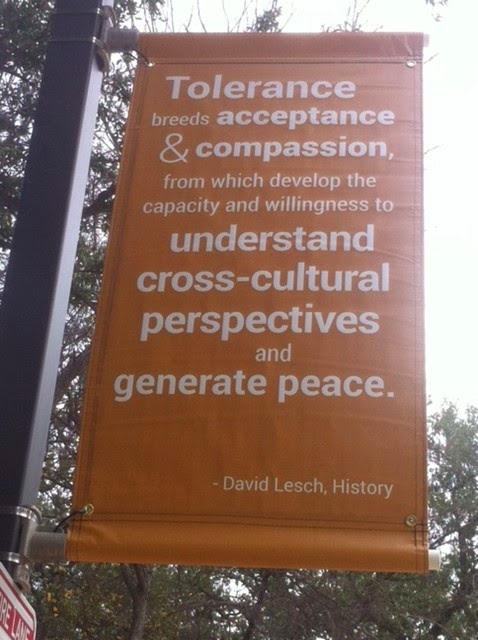
I have to admit, I was lukewarm about the banners that recently sprung up around campus. Like Epcot Center, they just seemed too educational and not Magic Kingdom enough. Maybe this is why some faculty members have called me anti-intellectual (whatever that means). Then I heard Interim President Mike Fischer raving about them, which pretty much convinced me I was right. So in January, while meeting with the RAs, I asked their opinions. To my surprise, they loved them too. For the simpler people on campus, such as myself, I thought I would put the quotes into plain language, Cliff Notes style.
Please have some fun matching the banner photo, above, with the paraphrased quotes below. I have cleared these with the professors themselves.

A. "Be optimistic, even if you are a prominent expert on the Middle East"

B. "Grades aren't everything."

C. "Work hard, Play hard."

D. "There's a fine line between camping and Biology."

E. "Come check me out in the weight room."

F. "Don't waste the money someone is spending for you to be here!"

G. "Please take my course on the Aeneid."

H. "This is why you aren't in Platteville."

Answers: 1-B, 2-A, 3-E, 4-H, 5-C, 6-G, 7-D, 8-F