Google Analytics Tracking Code

Friday, July 8, 2016

Black Friday

The day after law enforcement officers were gunned down in Dallas is a sad one. This followed unbelievable incidents involving shooting deaths of young black men by police the previous day. We have a lot to process.

I am so impressed with the reaction of celebrities, political leaders, friends, and colleagues to the horrific and ongoing horrors perpetrated against the black community. The depth, sensitivity and honesty in reactions warms my heart. I am humbled by others and feel I simply can't add to the commentary in a meaningful way. These are not new incidents (never miss a chance to invoke Bruce Springsteen). They are just on video. Like photos of black lynchings, with smiling KKK members posing with pride, the imagery of brutality is unfathomable and jarring.

But we have a choice: Don't react and be complicit, or react and risk being misunderstood for offering up empty platitudes and not understanding. I will choose the latter.

From an emotional standpoint, as an ally, I can't say it any better than white Trinity alumna Kaela Dickens from her Facebook post yesterday: 

"To my friends of color, I am so sorry. I am so sorry that you may fear for your life in what should be completely safe situations. I am so sorry you have to worry about being perceived as dangerous, simply because of the way you look. I do not know what it is like to live in that reality. I recognize my exceptionalism. I wish I could give it up to keep you safe.

I will not tire from loving you, from working to spread understandi
ng and peace, from demanding justice, from inciting real change, and from standing WITH you, my precious, strong friends."  


The number of posts from my black friends on Facebook have overwhelmed me as they speak out in fear, anger, sadness, shock, hurt, confusion, frustration, fatigue, hopelessness, and wisdom. I know, this sounds dangerously close to saying "I have a black friend..." But my work has brought me close to our students of color and my profession is very diverse. I have evolved and learned much from them and the issues they face. I'm not done.

My young black female friend and colleague, Amma Marfo posted this
:

"I've been touched and floored by the number of friends, White and non, who have reached out to check in on me. Many have asked what they can do to help, or have expressed an interest in knowing what they can do. I didn't have an answer for a long time, but I have one now.
Use your voice in places where it counts. If you truly feel that police brutality against Black and Brown bodies is wrong, say so. Loudly, often, and in places where it counts. Vote against politicians that turn a blind eye to it. Vote against politicians who have stances that would make this state-sanctioned violence. And challenge friends and family members who believe this isn't a problem, or that the people perpetrating these acts are justified in doing so. They aren't. They aren't, they aren't, they aren't. Speak up. Loudly, often, and where it counts."

Professionally, I need to work to help our students feel that they are physically and emotionally safe here. I need them, my family, friends, and colleagues to know I won't be silent. I have been reading their posts and I think I can offer up some of the things I have read, interpreted, and felt. For those wondering what we can do, here are some thoughts:

1. Political views aside, listen to our President and allow him to lead. We are blessed to have an intelligent and compassionate leader who communicates with grace, candor, and integrity. Support him.

2. We have to educate ourselves, all the time. Books aside, there are terrific voices out there in the media. I particularly like two people who spoke at Trinity in the past. If you are on Twitter, follow Marc Lamont Hill (@marclamonthill) and Tim Wise (@timjacobwise). On CNN, Van Jones is emerging as a tremendous commentator and spokesperson (@vanjones68). And follow the aforementioned young Amma Marfo (@ammamarfo).

3. Listen a lot and avoid the urge to say "yeah, but..." Just listen. Sure, there are anecdotes everywhere about good and bad white and black people. The issue is bigger than that and individual stories illustrate the problems but are symptomatic of bigger issues.

4. Check on your friends of color and ask them how they feel and tell them you care.

5. Ask questions, raise issues, challenge... Don't swallow thoughts and feelings. Take risks by talking about hard and difficult topics.

6. Don't counter "Black Lives Matter" with "All Lives Matter." Others have said this better than I. All lives do matter, of course. But not all lives are lived with the same risk of having violence perpetrated against them at any time based on the color of their skin.

7. We have no problem celebrating the greatness of our forefathers on Independence Day. So let's acknowledge the shame they brought our nation through slaving. We have to accept both and acknowledge our heritage brought people here against their will. We are suffering the evolving consequences of a real legacy. 

8. Acknowledge that systemically we have a society that honors privilege; that there is not equal access to quality education; that poor education can lead to poverty which can lead to crime; and acknowledge the unfairness of the criminal justice system. Blaming people for the circumstances they were born into is unfair.

9. Vote for those who have agendas to fight these systems that are not in any way equitable. Don't worry about getting what's yours, worry about everyone getting theirs. The American dream should be for everyone.

10. Empathize. I used to lead a program called Archie Bunker's Neighborhood. Essentially, random groups were assigned to occupy unequal parcels of space and have unequal access to supplies and resources to build a community. Inevitably those in the privileged, larger space were oblivious to the other communities, and constructed lavish parks and residences. Those in the poorer community with less space always ended up chanting, singing, and knocking down cardboard structures in the other areas. If people can feel this level of frustration in an EXERCISE in an hour, imagine a lifetime of it. Then do something to help shift the social and political systems that reinforce and perpetuate these environments.

To summarize, I felt like an impostor at last week's Pride parade and feel the same now. I can go home and still be straight, and white. I have little credibility. When we see our black students or communities gather together it's not because they are racist, it's because they can't ever shed their color and their heritage. They live in their own skin all the time. So, I hope none of my words are offensive, tone deaf, self-serving, or preachy. If so, I apologize. Push back. Educate me. Like most, I just have nothing else to offer.

Monday, June 20, 2016

Fond Farewells

Senior speaker Maddie Smith with me.
As the 2015-16 year came to a close last month there were many celebrations and farewells. Most notably, we bid adieu to the Class of 2016 through a number of farewell activities concluding with an excellent commencement. The student and featured speakers were outstanding. You can access those on the Tiger Network and they are worth watching. The alumni speaker, Valerie Alexander received a standing ovation. Well deserved at that.


Graduate Ingrid Harb and her mom at the Last Great Reception.


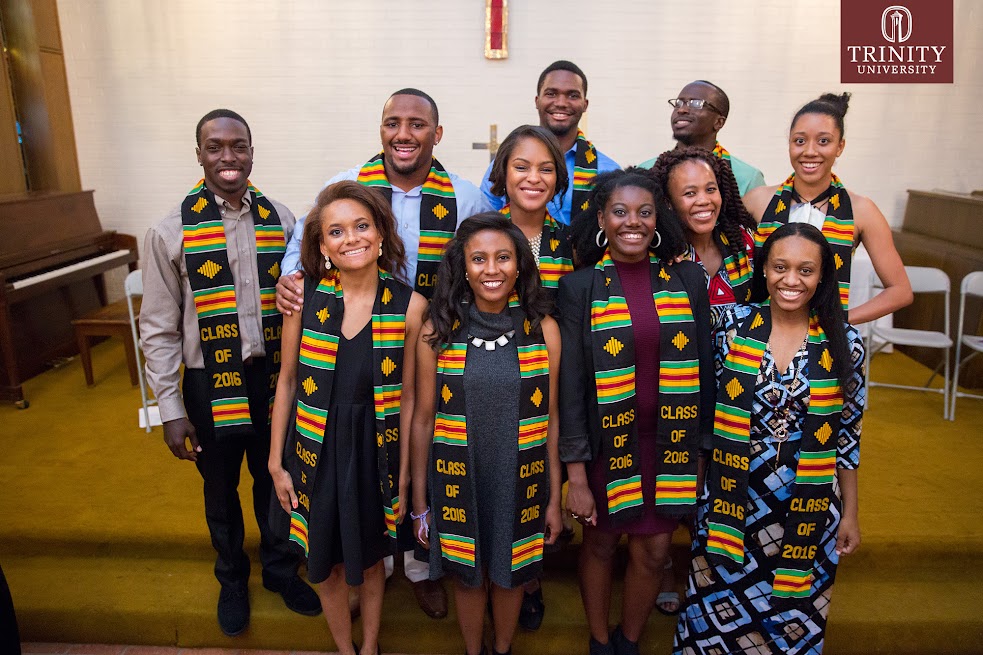
In addition, some of the students on campus initiated the first Kente ceremony for black students. It was held the night before the full commencement in the chapel. John Jacobs in Student Involvement and others assisted students under the leadership of Martel Matthews. Many staff members from Student Involvement and President Anderson attended this joyous and family-centered celebration that will assuredly become a new Trinity tradition.


Also, there were several retirements and several staff members have moved on to different challenges and opportunities. Several times this blog has allowed me to write about the working community at Trinity (see the "collegiality" label at right). Below are just a few photos from some of the farewells.

IMHO the staff missed the perfect chance to say "Soi Long, Farewell!!" on their sign... Soi Inthavong Smith was our Coordinator working with diversity and multi-cultural issues and had an impact on many individual students and organizations.
After eight year, Edwin Blanton left his post working with Experiential Learning, Service Learning, and Community Service to take a position with another school in San Antonio. Simply the best, Edwin is caring, student-centered, and driven by social justice. 

With changes in our administrative structure I am rotating off of the executive team. Our new Vice President for Student Life, Dr. Sheryl Tynes, will assume this leadership position. I'm not going anywhere. But President Anderson acknowledged the end of my tenure with this group with a terrific chocolate cake at my last meeting. Colleague and VP Gary Logan (seated and on his laptop) seems pretty broken up about it all.

Saturday, April 23, 2016

Free speech, safe spaces, and HWSNBN


The recent speaker on campus has certainly sparked conversation, though for many of the wrong reasons. Everyone is sick of this topic so I will not even identify him, and simply refer to him as He Who Shall Not Be Named (HWSNBN). There are several issues related to his visit: open dialogue and free speech; hate speech and safe spaces; and the role of the University in navigating all of it.

Briefly, the new student organization, Tigers for Liberty, wanted a counter program to one on micro-aggressions. They invited HWSNBN, booked a space, and started publicizing the event before it could be vetted by staff. At that point, and because there was really no mechanism in place to cancel the event, it went on, though not without concerns. Those concerns were primarily around quality, education, and a student group being co-opted by a speaker and movement from others off campus. I think that's enough background.

Ideally, when students are subject to individual and boorish racist and biased attacks our student community will set the threshold and expectations for their environment. Part of their learning experience is to step up and push back rather than have us swoop in and save them. At the same time, the administration must always support them and declare clearly that the institution deplores such conduct.

I am a huge proponent of free speech on campus. I have deliberately avoided introducing time-place-and-manner policies because they limit and "manage" protests. Hate-speech codes have been routinely struck down by the courts. Indeed, our students are generally polite, respectful, and uncomfortable protesting lest doing so might make them seem weird. They just aren't good at it, historically. The key policies for us relate to harassment of individuals and disruption, through our Respect for Community policy. Shouting at an invited speaker for whom we might pay thousands, interrupting classes, or harassment are the primary actions that would draw conduct responses.

What students had hoped for with HWSNBN was a quality program worthy of the speakers we bring to campus as well as the educational programs we host. I did not attend, but by most accounts, HWSNBN just offered crude and shallow opinions, mostly meant to shock and incite as well as turn a profit.
My guests and teachers.

This week, at a program I hosted with the Black Student Union and the Black Male Leadership Initiative, I was asked why the University would sponsor such a speaker. The truth is, we didn't. A student group did. But we didn't stop it either. Halting a program in motion is a sure way to feed the furor of conservative groups over free speech and censorship. Which is what they often want.

The problem with free speech proponents is that while many present their political and social views under the auspices of free speech, they are often rooted in bigotry and oppression. Certainly libertarian viewpoints, capitalism, "less government" are valid perspectives and ideologies. Unfortunately for many, the progression plays out like this: we want to keep ours (resources and power)... others haven't worked for or earned theirs... others are lazy, poor, and want entitlements... these people are often not like us (white, Christian, American, wealthy)... these people are unworthy and threatening.

Yes, I know it is a generalization. But look at the national political landscape. Often, people in places of privilege got there because they had a head start, through birthright, luck, and passed-on wealth. When those who haven't been so lucky ask for respect, validation, and a fair chance, they are seen as militant or whiny or lazy. When they speak up and demand fairness, justice, and respect, then those in privileged places often push back. This is fertile ground for incredible dialogue. However, HWSNBN, and the likes of Donald Trump rarely want to engage in substantive and meaningful conversations. They zero in on the qualities they claim make others "less than." So those with different gender orientations, skin colors, and nationalities are mocked and attacked. They are restricted from bathrooms, educated in worse schools, jailed in higher numbers, kept out by walls and fences, and discriminated against because of their faith and turbans.

I am so proud of our students. I think the Tigers for Liberty, the Trinity Diversity Connection, and the Trinity Progressives are mostly educated, respectful, and open-minded. But the event with HWSNBN brought in others who resorted to chants for Trump and "White Power." Really.

When the black students I met with explained to me that this speaker created an unsafe environment for them, I had no response. They weren't just offended. They saw and heard a small number of students and a larger number of guests marginalize them in a way that was hateful and potentially violent. "How is this reflective of Trinity's values?" asked one. It isn't. We are not values free and we strive to create an environment for ALL of our students that honors their humanity.

Make no mistake, free speech is welcome, expected, and encouraged here. But using free speech as a ruse to spew hate and discrimination is a cheap trick and is disingenuous. Those in power will contend that offensive words and ideas are part of a society and come with dialogue and disagreements. Usually though, it is because they are the aggressors. Of course they don't mind. Those who are attacked don't feel that way. While I tend to agree that generally we are too sensitive and too easily offended, I also firmly believe that in order to learn from others we need to have open and civil discussions and to risk offending as a cost of learning and educating. Free speech as a mechanism for bullying, however, isn't acceptable, not just on campuses, but anywhere.

Moving forward, we will do a better job as a University in developing and producing guidelines for campus speakers and events, particularly those that draw external audiences bent on hijacking the educational experiences of our students in order to promote their own agendas. We routinely take heat for the speakers on the Israeli-Palestinian debate. Those are intellectual and yes, emotional discussions on difficult topics. But these programs and others create robust and necessary conversations that are part of the educational experiences. They aren't designed to put others down.

Students like the one asking about our values are right. We do stand for something. And if we want a diverse community we have an obligation to protect and nurture it. It is our responsibility to vet the speakers, not for their ideas, but for their value and for their adherence to ideals of respect and conflict with civility. We need that on campus and students here should demand it. How else will they know how to demand the same when they face similar issues out in the world once they graduate? There will be many more Milo's. Students need to know when and how to call them out. And they need to know them by name.They have had a good start.

Tuesday, April 12, 2016

Teach your children (well)

This is primarily written for my parent audience, with the misdirected hopes that their students will listen to them more than they listen to me...
Recently the Crisis Management Team conducted a campus-wide active shooter training drill. This followed years of smaller tabletop exercises by the CMT and various departments, such as TUPD. The purpose of a large-scale drill is to test the response by campus employees, students, visitors, and guests. As a CMT we are always learning things and hope we never have to put those lessons to use.

As if this isn't enough for parents to worry about, a murder of a UT student on the campus in Austin around the same time amplified anxiety about safety on campus. Unfortunately, there are crazy people in a crazy world, one in which subways, schools, campuses, offices, airplanes, stadiums, clubs, churches, and movie theaters are under constant threat. This generation of parents was reluctant to let their kids play outside, and perhaps they were on to something. Ultimately, being in the wrong place at the wrong time can lead to tragic results. And then sometimes we simply need to be lucky.

Nevertheless, there are some things college students can do to try to tilt luck their way just a little.

1. Prepare
The performance of our students in the recent drill was pretty positive on the upper campus in the academic and administrative buildings. In the residence halls it was woeful. Perhaps it is because they knew it was a drill. But we all know, how you practice is how you play. Residents mostly saw the drill as an inconvenience. On the upper campus we had more success, because the faculty and staff had more direct responsibility and impact. Even then, I encountered students blissfully ignoring warnings because, well, they had to study.

Parents, urge your students to participate in drills and respond to alarms. It could save them someday. Also, have them review our really well done web pages on emergency preparedness and TUPD procedures (excellent links on the left side of that site).

2. Use campus resources
Students are welcome to call TUPD for escorts at any time. Sometimes they are reluctant because they don't want to wait. A nice alternative is the under-utilized Elerts app, which enables a student to walk while holding a panic button on their mobile device. Releasing that button triggers an almost immediate response from TUPD.

3. Practice safe habits
This is always dangerous, because asking people to take precautions can be perceived as victim blaming. Victim blaming is something that is usually done after something bad happens and is directed toward an individual. We all have the right to not be mugged, to jog at night, and to go where we want when we want. Sometimes we do all the right things and bad things still happen. A group of students can be held up at gunpoint (it has happened) just as easily as an individual student can have a knife pulled on him or her (that happened too - a long time ago before dorms were locked).

But here are the basic harm-reduction strategies parents can stress with their students: travel in a group; be aware of surroundings; trust your gut feelings; use a designated driver; use seat belts; run in daylight; lock your room; only let people you know into buildings; and report suspicious activities.

A huge risk factor is alcohol. Urge students who drink to at least use the Optimal Buzz guidelines and avoid alcohol from public source containers (punch). Probably more good than bad has happened as a result of over-consumption, though most have to learn this by experience.

4. Keep your guard up
Students can very easily be lulled into a false sense of security. They will leave clothes in the dryer for days, walk away from laptops to get a snack, leave their balcony doors unlocked, and confuse a bubble for a fence.

It is natural for people to be vigilant after something bad happens. Sustained, reasonable, and appropriate concern can go a long way in helping students be safer. 

Thursday, March 31, 2016

A moment to be grateful for


On March 30, 2015, five first-year students were involved in a car accident near campus. Four were hospitalized with a range of injuries. Corey Byrnes died at the scene. A year later, Trinity University paused to recognize the one year anniversary of this tragic day, and dedicate a bench in Corey's honor. The site was selected by his friends near their residence, Calvert Hall. Here are excerpts from the remarks and a video of the fairly brief but moving ceremony is included in this post. (Video by Tim Zhang.)

Dean of Students, David Tuttle
Unfortunately, we have lost students and young alumni before. If you walk this campus you will see their memorials. For all of these young people, their friends and families felt it was important to have a market, somewhere here, that expressed that these young people lived here, learned here, studied here, played here, and mattered here. What an incredible honor it is for us as a campus to celebrate their lives in these tangible memorials that reflect how much they mattered to us too. When we pass this spot and when you come back to visit as alumni, you will reflect on Corey, and his life, and your grief, and how they are inseparable and permanent.

Class of 2018 Alumni Sponsor - Leni Kirkman
I don't want to stand here putting words in the mouth of your dear friend Corey - but I'm pretty sure he's left us a good recipe for living. Putting aside the pains of the past, and our worries for the future - and finding happiness in the present: Easy to say, much harder to do - but I think that is what I will try to do each time I come sit on Corey's bench.

Chaplin, Stephen Nickle
March 30, 2016
We gather on this anniversary of his death feeling a mixture of sadness and glad memories. We gather to dedicate this bench in Corey's memory, to mark in an explicit way our gladness at having journeyed a piece with him, and our sadness at his death. Lord, this memorial bench created a space of rest and encounter: of shared laughter, of honest argument, or trusting vulnerability -- all of which were precious to those who knew Corey, all of which are precious to each of us in many other friendships.

Class of 2018 Class Marshal, Jennifer Henderson
Corey was a student in my first year seminar course - a course on Women and Technology in Media. This is a course he didn't really expect to be taking, but one he was game to dive into. I can see Corey on the left side of the classroom, five seats down. I can see him raising his hand anytime we talked about video games or movies. When I remember Corey, all of the snapshots are of him laughing. Laughing with his friends. Laughing at my inability to get the computer projector to work...again. Laughing at himself. Corey laughed a lot. He laughed easily and sometimes for not outward reason at all.


Friday, March 4, 2016

Kindred Spirits

Drinking buddies.
"People contact me all the time and say 'your story is MY story." So said author Sarah Hepola to a riveted crowd in Laurie Auditorium on Thursday (March 3, 2016) at an event sponsored by the Coalition for Respect and Greek Council. Well, I was thinking the same thing. I have revealed my own drinking history to the campus, first in a 2004 Trinitonian column (that time Spurs owner Peter Holt was the catalyst) and in countless welcome and diversity speeches at New Student Orientation.

I like to talk openly about my dysfunctional family history, my drinking, and my social anxiety. I want students to not see me as a bland and condescending bureaucrat. I want my failures to make me approachable and a safe resource for students when they hit their lows. How can I judge given the things I have done? And there are plenty of adults like me around campus that students should and do look to during their most vulnerable moments. So of course I am drawn to Sarah's candid and blunt accounts of her black-out history. Forgive me for gravy-training.

Sarah's talk triggered a flood of liquid gold memories for me. It has been over 30 years after all, so I don't go back there very often any more, back to the spirits and ghosts. The consistencies between our stories - and apparently the stories of many - are both shocking and yet not at all surprising. I will spare the details of my past, except to say I imposed blackouts on my self nearly every weekend for several years running during college. It didn't stop afterwards, and that's when I knew I wanted to forge a different path for my own yet-to-be-created family.

Dinner with the speaker and Trinity people.
Like Sarah, I felt emboldened by my alcohol use and belittled others as amateurs. Most striking in her speech were these incredible nuggets: knowing from the first time that this was a problem; treating non-drinkers as less-worthy "light-weights;" hiding behind one-night stands and cigarettes as adventurous and cool; and building a drinking identity that masked fears, anxieties, and low self-esteem.

Interesting and sad stories we have to tell. But what is the take-away for our students? Sarah was spot on from the start when she told students that she wouldn't tell them not to drink or drink less - because they probably wouldn't listen. At the end of the day students will make their own choices and take their own risks. And there are lots of risks. What I had in common with Sarah was the fun, exhilaration, transformation, and brazenness alcohol created. How dare either of us serve ourselves up as cautionary tales? The best way is to name it: that if students feel the way we did about their relationship with alcohol, then they should take pause. Serious pause. Look at the full arc of our stories to see the almost cataclysmic results that somehow ended in at least some redemption.

Some of my history guides my thinking in leading policy discussions on campus. The Optimal Buzz and B'Low Optimal programs acknowledge that students will drink but gives them incentive to do so moderately. Currently, we are fully reviewing our off-campus alcohol policies and guidelines with the Athletic Council and Greek Council. (That will be another post altogether.) I anticipate revisions that shift responsibility to individuals more than groups and that further strengthen our commitment to student health and safety above policy enforcement.

Sarah described college as that fun time of freedom between adolescence and adulthood. Why wouldn't students have fun with alcohol? By describing her experiences in Black Out, and taking her story to college students Sarah Hepola is offering up an important and very personal story.

Over dinner with a group of students, staff, and faculty at a local restaurant, Sarah answered questions, spoke with passion and humor, and was candid about her story and the culture of drinking. As our waitress, Amber, thanked us for our business, she revealed, tearfully, that she herself was 263 days sober. "You should listen to her," she said of my new kindred spirit, and hers. "She speaks the truth," said Amber. She does indeed.